1,000 Years of Innovation: Why Nomads Are the Secret Sauce of Human Progress
Nomads aren’t just people who move; they are the “scouts” of the human race. Throughout history, whenever humanity was stuck in a rut, it was the wanderers, the traders, and the explorers who brought back the “new” stuff—new seeds, new tools, and new ways of thinking.
By the end of this read, you’ll have a fresh perspective on:
The Nomad as a Messenger: Why wanderers (from Roman traders to Silk Road merchants) were actually the world’s first “data cables,” carrying ideas across borders.
The Power of Portability: How inventions like the printing press and paper money were the “original cloud software” that allowed people to carry their lives in a backpack.
The Speed of Change: Why it took hundreds of years for a coin to become popular, but only a few months for AI to change how we work. (no it’s not just you feeling like your on a fire horse at full gallop and not being able to hang on)!
Cognitive Leverage: Each era has a nomad lesson for us today to leverage the new tools of AI. It is not a “how to” blog it’s a big picture perspective read.
Read Time: Approximately 4–5 minutes.
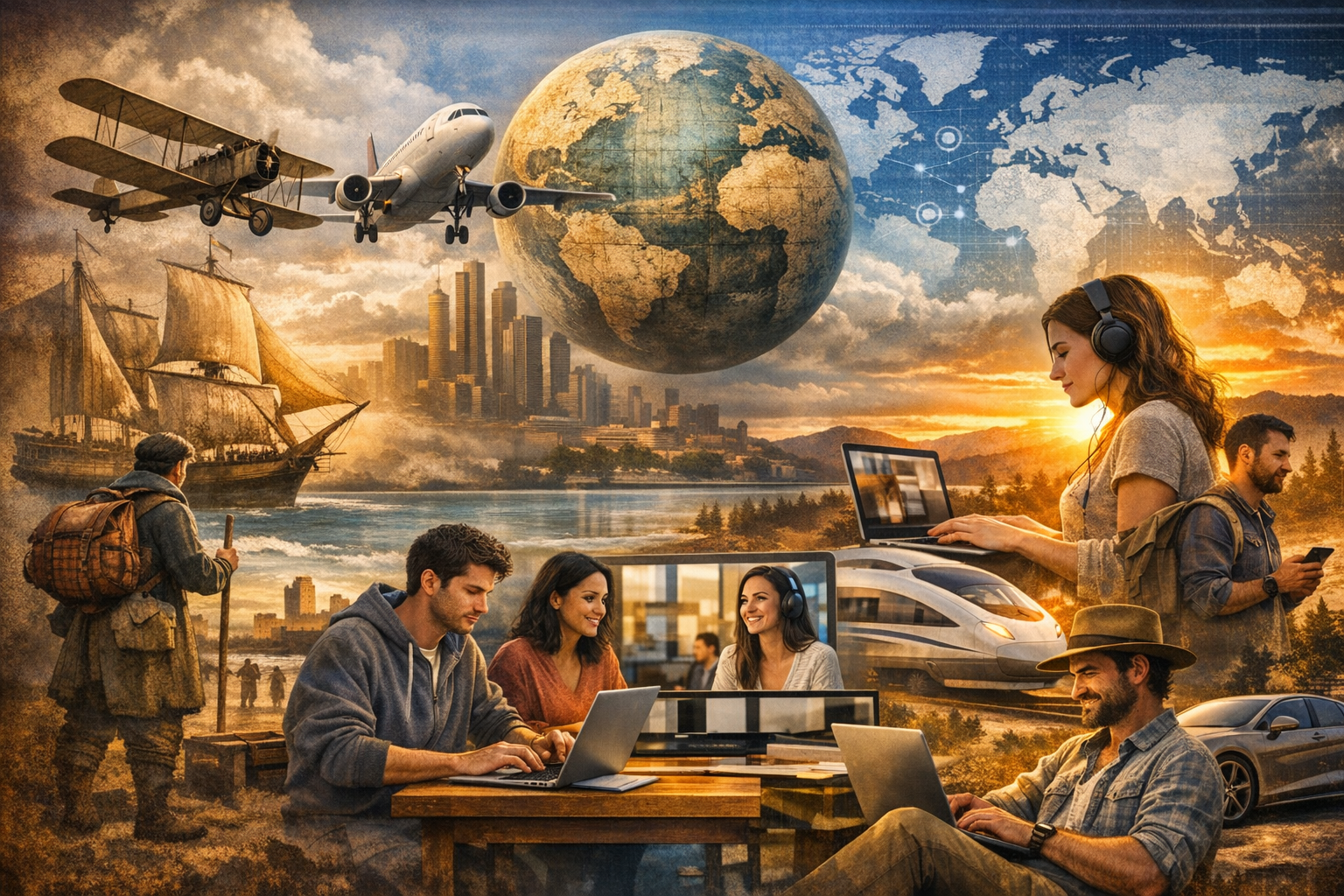
This blog isn’t just a history lesson; it’s a roadmap for the future of work and a reference point to understand human behaviour. It reframes the “digital nomad” lifestyle not as a modern trend, but as the latest chapter in a 1,000-year-old story of human bravery and brilliance.
Today, the internet has enabled work from anywhere, AI has enabled one person company’s with the use of AI agents to run the majority of the business this enabled the “modern nomad” to be location independent, but being a nomad and being a traveller is actually an ancient human superpower. Let’s look at how the innovation of the past created pivotal moments that changed us and why the world is spinning faster than ever before.
Why This Matters Right Now
Times are changing fast and this blog explains why you feel that way everything is going a breakneck pace. It explorers why humans are naturally designed for movement and adaptability. It shows that being location-independent isn’t “running away”—it’s running toward the next stage of human evolution.
By understanding that technology adoption is getting shorter, you’ll realize that “learning how to learn” is more important than any specific job skill. Just like a pilot needs to trust their instruments during a storm, this may help you understand history and where we are today. To put things into perspective so you can embrace the digital tools (AI, Cloud, Crypto) that give you the freedom to fly solo across the globe. Let’s go way back.
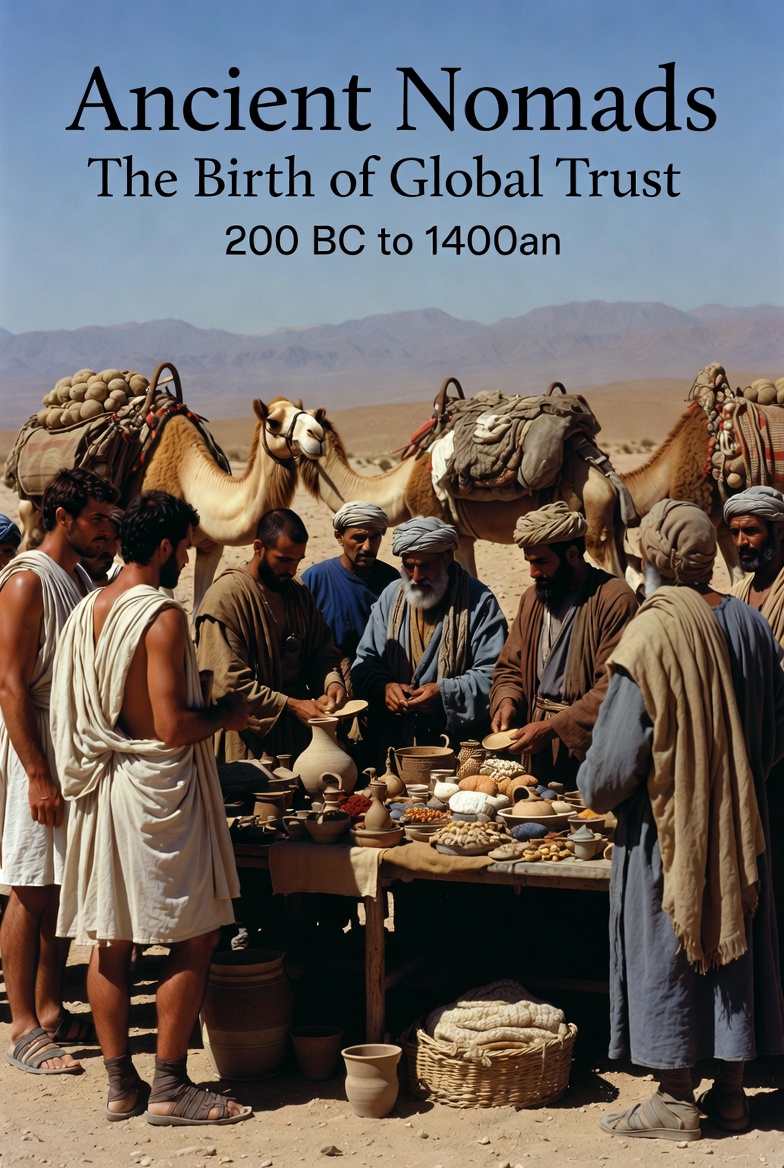
1. Ancient Nomads: The Birth of Global Trust
The Era: Romans & Silk Road Traders (approx. 200 BC – 1400s)
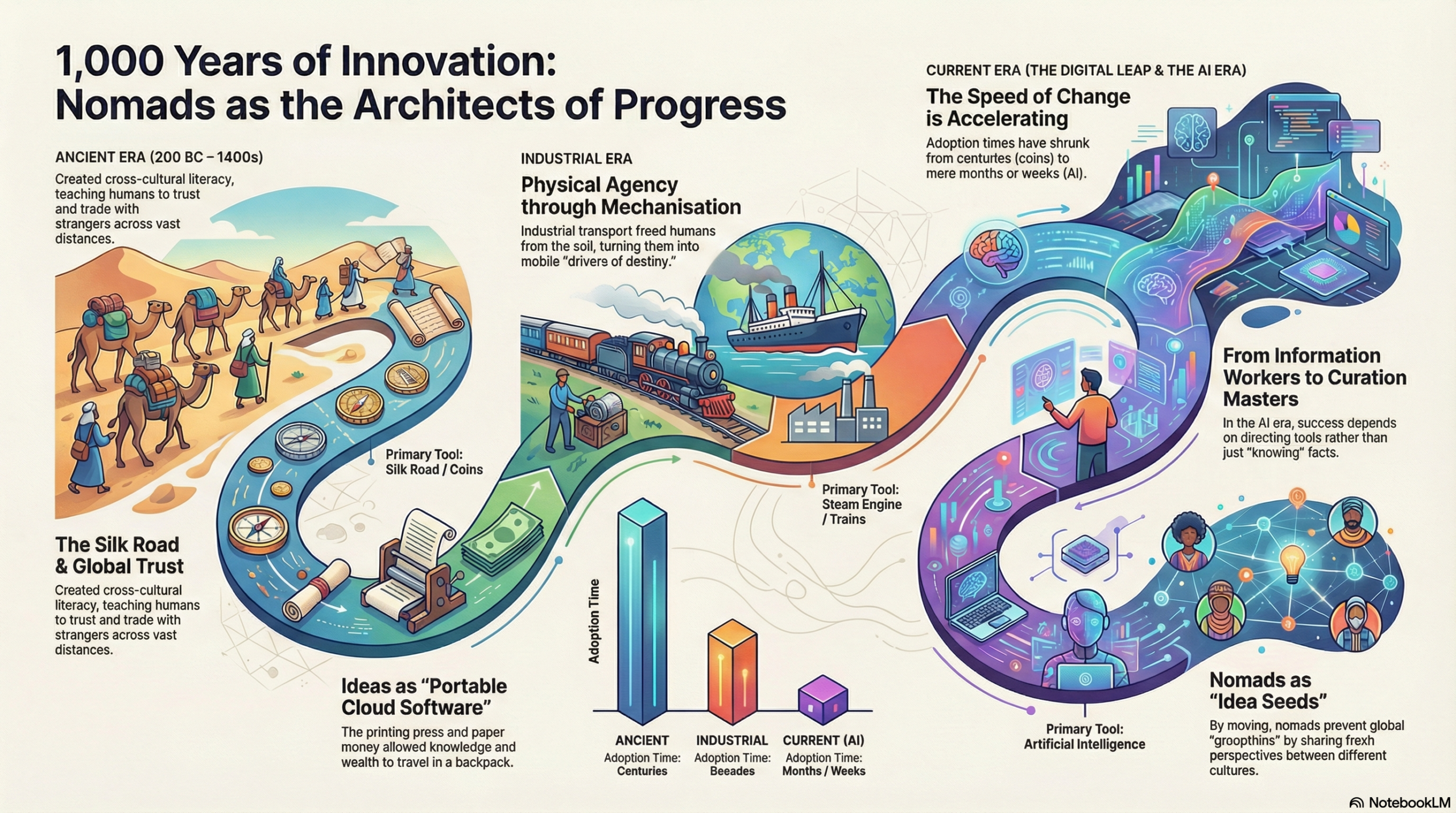
Before these legends, if you lived in a village, you likely died in that village. You only trusted people you knew by name. The Silk Road changed the “coding” of the human brain. Merchants had to travel thousands of miles across deserts and mountains, relying on “letters of credit” (early banking) and the kindness of strangers.
How it changed us: It taught us Cross-Cultural Literacy. We learned that a person with a different language or religion could still be a reliable business partner.
The Nomad Lesson: You learn to read the “vibe” of a room—or a country—instantly. This resilience is the bedrock of the nomad mindset.
2. The Age of Discovery: Expanding the Mental Map
The Era: 1400s – 1700s (The Great Explorers)
Imagine flying a plane into a storm without an altimeter or GPS. That was Marco Polo and Columbus. They used the stars and early compasses to find places that “didn’t exist” on their maps.
How it changed us: It shifted humanity from a mindset of Scarcity (protecting what we have) to Curiosity (finding what else is out there). It made “The Unknown” a place of opportunity rather than a place of monsters.
The Nomad Lesson: Growth only happens when you cross the border of your comfort zone. If you aren’t a bit nervous, you aren’t growing.
3. The Printing Press & Paper Money: The First “Cloud”
The Era: 1440s (Gutenberg) and the rise of formal banking.
The printing press was the “Internet 1.0.” Before this, knowledge was locked in monasteries. Suddenly, ideas could travel in a backpack. Paper money meant you didn’t have to carry 50kg of gold to buy a horse in another country.
How it changed us: It Democratized Knowledge. When everyone can read, everyone can lead. It allowed humans to coordinate across vast distances using shared “data” (books).
The Nomad Lesson: Portability is power. The less you “own” physically, the more you can “carry” intellectually.
4. Mechanized Transport: Freedom from the Soil
The Era: 1800s – early 1900s (Trains, Planes, Cars, Tractors)
For 99% of history, humans were tied to the land to eat. Mechanization freed our hands. Tractors did the work of 100 men, and trains allowed those 100 men to go find work in the city—or another country.
How it changed us: It gave us Physical Agency. We stopped being “parts of the landscape” and started being “drivers of our destiny.”
The Nomad Lesson: Technology should always serve your freedom. If your tools require you to sit in one chair all day, they aren’t tools—they’re anchors.
Why is Adoption Getting Faster? (The “Snowball” Effect)
You’ve probably noticed that while it took centuries for paper money to become common, it took only years for the iPhone to conquer the world. Why?
Infrastructure: Each invention builds a “road” for the next. The printing press built the literacy needed for the telegraph; the telegraph built the wires needed for the internet.
Frictionless Sharing: In the 1700s, an idea moved at the speed of a horse. Today, an idea moves at the speed of a “Send” button.
Compounding Interest: Technology is like a snowball rolling down a hill. The bigger it gets, the more “snow” (data/innovation) it picks up with every single turn.
| Era | Primary Tool | Adoption Time | Human Impact |
| Ancient | Silk Road / Coins | Centuries | Created global trade networks |
| Industrial | Steam Engine / Trains | Decades | Shifted humans from farms to cities |
| Digital | Internet / Laptop | ~10-15 Years | Untethered work from location |
| Current | AI (Artificial Intelligence) | Months / Weeks | Cognitive Leverage (Thinking at Scale) |
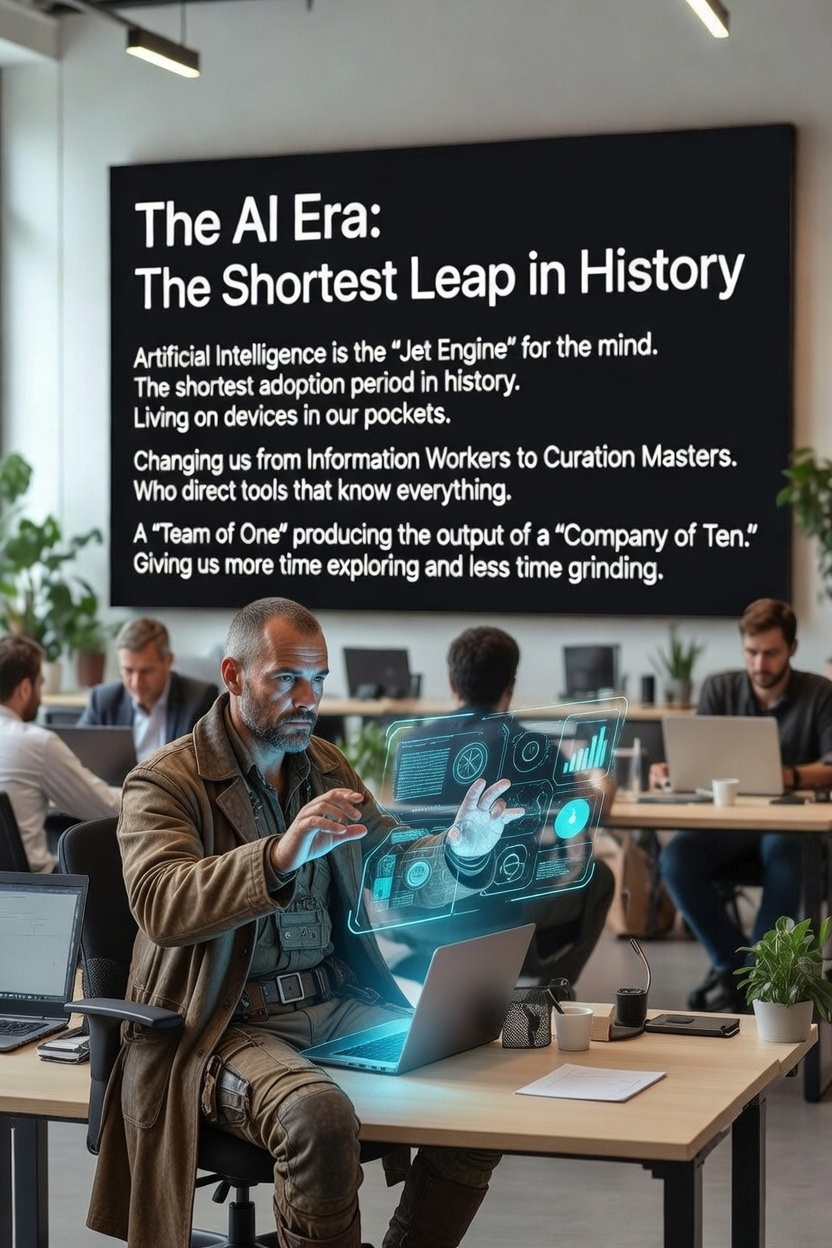
5. The AI Era: The Shortest Leap in History
Artificial Intelligence is the “Jet Engine” for the mind. It has the shortest adoption period of about 5-15 years because it doesn’t require us to build new factories or lay new cables—it just lives on the devices we already have in our pockets. It’s no longer science fiction it’s here, and we all have a responsibility to train it for good, so don’t think it will take your job, think how you can train it for the good of all, even if it is on a micro level.
How it’s changing us: We are moving from Information Workers to Curation Masters. We don’t need to “know” everything; we need to know how to direct the tools that know everything.
The Nomad Lesson: AI allows a “Team of One” to produce the output of a “Company of Ten.” For a nomad, this means more time exploring and less time “grinding.”
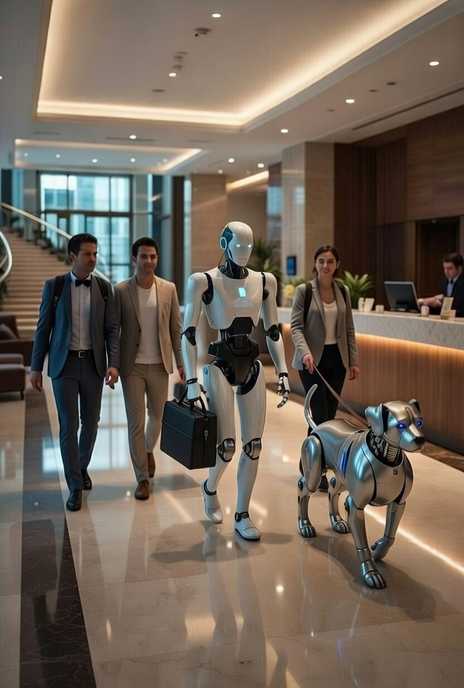
Now, this year 2026 it is the humanoid era and it begins as they are being adapted into homes and businesses to interact with the world. the prediction by the big companies producing Humanoids is that by 2035 there will be billions of these in the world. Think about how will you feel when you start seeing humanoids assistants checking in their families next time you checking at a hotel!
Why Nomads Change the World
Nomads are like the wind—they carry the “seeds” of ideas from one place and drop them in another.
A nomad in Bali sees a new way to manage waste and tells a friend in Lisbon.
A remote worker in Medellin shares a specific coding shortcut with a team in Sydney.
By moving, we prevent “Groupthink.” We challenge the status quo because we’ve seen ten different ways to solve the same problem. Nomads are the world’s primary source of fresh perspectives.
Closing Thoughts
Whether you’re riding a BMW across a continent or sitting in a co-working space in Chiang Mai, remember: You are part of a 1,000-year-old tradition of progress.
The world is moving faster, and the “hustle” of the 9-to-5 is becoming a relic of the past. Embrace the tools, trust the systems, and keep your mindset as mobile as your passport.
This blog was created by nomads for nomads. So where to next?
Created By Linda A. McCall with the use of AI, Co pilot, Grok for photos





Pingback: 1,000 Years of Innovation: Why Nomads Are the Secret Sauce of Human Progress - Planet Nomad News